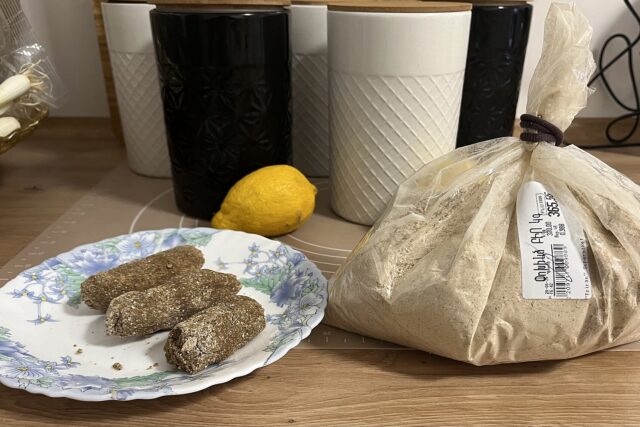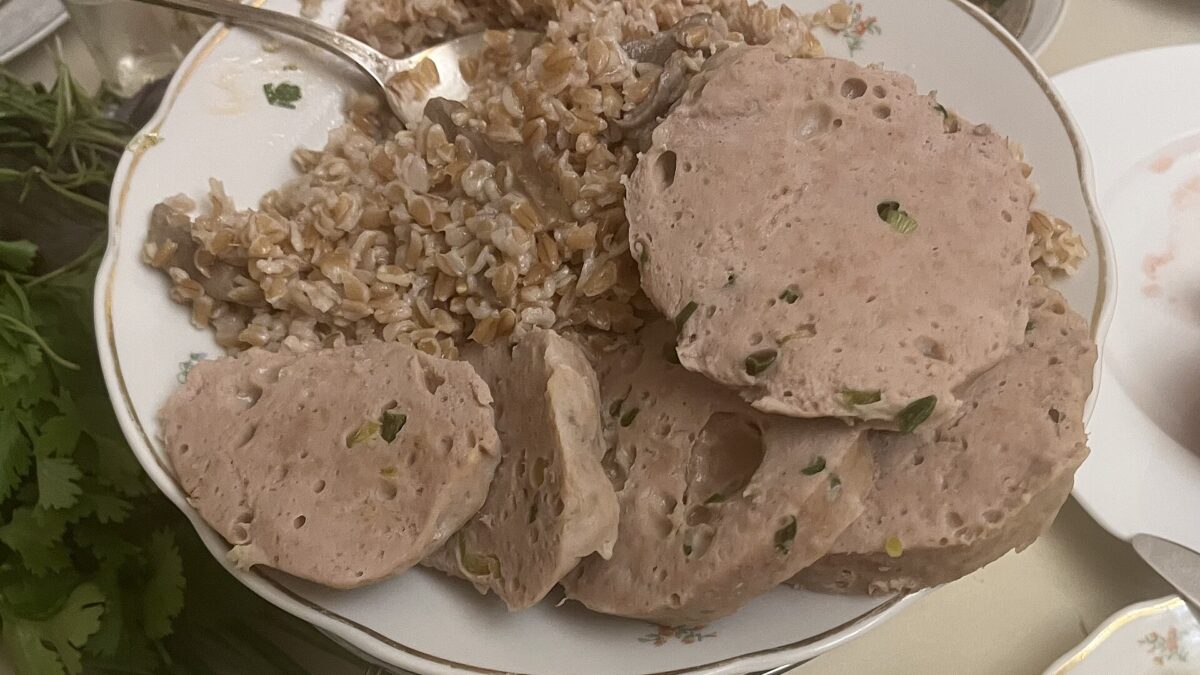
Armenian kyufta is lean beef beaten into a paste, formed into fist-sized balls, boiled, then sliced and finished with butter. It has nothing to do with grilled Turkish köfte. Two towns own the reputation: Echmiadzin (Vagharshapat), which has a whole street of kyufta makers near its market and a kyufta festival, and Gavar on Lake Sevan, whose version adds egg, flour and onion and now has its own gastro-festival. Below is what actually differs between them, what is and isn’t sourced, and where you can realistically eat each.
What Armenian kyufta is (and isn’t)
The word comes from Persian kūfta, “pounded,” and that is the whole point. The meat is beaten until it loses its grain and turns into a pale, elastic mass, mixed with a little liquid and seasoning, shaped into large spheres and simmered in salted water. Phoenix Tour’s write-up of Gavar kyufta puts the texture well: closer to a mousse or soufflé than to a meatball.
It is not köfte (no grill, no coarse mince), not ishli kyufta (the bulgur-shelled stuffed one, covered below), and not served with trout: butter, sometimes broth or an onion sauce. For the wider picture first, see our Armenian food guide.
How it is made: the beating and the boil
1. The beating
Traditionally the beef was sliced thin, laid on a flat stone and beaten with a wooden mallet, with water and salt worked in gradually until the meat turned pale and stretchy (Phoenix Tour; eurasia.travel). Most kitchens now use a grinder or food processor. Armenian-American cook Heghineh runs the meat for 5 to 7 minutes, adding cold water in stages until it is “shiny, silky and very smooth.” The old test still applies: the paste should go from red to pinkish-white before anything else goes in.
2. The mix
This is where regions diverge. The common additions are egg, a spoon of flour, milk or water, minced onion, salt, pepper, and a shot of cognac or vodka. The alcohol shows up in almost every Eastern Armenian recipe we checked, from the Echmiadzin street vendors (brandy or vodka, per the Kyufta Street profile on Armeniapedia) to ostarmenia.com’s Gavar recipe (50 g of cognac or butter). It is a texture trick, not a flavouring.
3. The boil
The balls simmer in salted water, never a hard boil, for 25 to 45 minutes depending on size: ostarmenia divides 1 kg into four balls and gives 25 to 30 minutes, skimming foam; Heghineh gives 40 to 45 for large ones. Cut one open: no red in the centre. Then slice into discs 2 to 3 cm thick and butter them while hot.
Gavar kyufta (Gegharkunik)
Gavar, the capital of Gegharkunik a few kilometres from Lake Sevan’s western shore, is the version most Armenians name first. Armenia’s official tourism site describes it plainly: chopped onion, egg and a bit of flour added to the beaten meat, salted, boiled, served. The egg-and-flour binder is the signature; it gives a firmer, more sliceable ball than the Echmiadzin style.
Two published recipes agree. Shabat.news’ “Kyavari traditional kyufta”: 1 kg meat, one onion, one egg, a tablespoon of flour, pepper, and 50 g of cold butter cubes worked into the paste, with water added half a teaspoon at a time while beating by hand. Ostarmenia’s is richer: 2 eggs, 6 tablespoons of milk, 2 onions, 2 tablespoons of flour and the cognac. Both finish the same way: boiled, sliced, butter on top.
The honest caveat on “kyufta capital.” No official or academic source crowns Gavar as the home of kyufta. What is sourced is reputation and momentum: the national tourism site lists Gavar kufta among Gegharkunik’s typical dishes, and in September 2026 the town held its first “Gastrofestival Gavar: The Taste and Aroma of Gavar,” organised by the Sarvor NGO with the municipality, with master-class demonstrations of Gavar kyufta, pakhlava and arishta (Armenpress). The organiser said she wants it to become annual. So: a new festival, not an old one, and a strong local claim rather than a documented origin.
Where to eat it: at the festival if your dates line up, otherwise in the restaurants and guesthouses of Gavar and the Sevan shore, where it appears as “Gavari kyufta.” Our Lake Sevan guide covers getting there. We have no sourced, named Gavar restaurant to recommend, and would rather say so than invent one.
Echmiadzin kyufta (Vagharshapat, Armavir)
Echmiadzin’s version is the refined one, and the one Yerevan menus name as “Echmiadzni kyufta.” The Armenian food blog Gata Pandok, the most detailed English source we found, says the meat is “beaten for a long time and then seasoned gently.” Many families add no onion at all “so as not to overshadow the main taste.” Rice goes into the paste. The balls simmer in a broth with bay leaves, a little pepper and very little salt, and come to the table with fresh greens, a spoonful of hot broth and a piece of butter: “extremely delicate texture,” “clean, deep, and smooth flavor.” It is a festive-table dish, usually made by the family elders.
Echmiadzin also has what Gavar does not: a dedicated street. “Kyuftachiner” (the kyufta-makers’ street) sits near the town market. A profile reproduced on Armeniapedia describes a vendor, Lusik Manukyan, 23 years in the trade, who cooked Thursday to Saturday and sold the rest of the week. Every household on the street makes it, nobody advertises, and townspeople will point you there if you ask for the “really delicious” one. Her baseline: whipped beef with brandy or vodka, onion and spices.
The town also runs a Kyufta Festival. The second edition was held on 8 October 2024 in Etchmiadzin Square, 1 pm to 6 pm, free entry, 30-plus booths, cooking demonstrations and a competition for best taste, look and idea (armenia.travel). The listing says it returned “after a lengthy hiatus,” so check the city’s calendar before planning around it. Vagharshapat is 20 km west of Yerevan; pair it with the cathedral and eat afterwards.
Other regional versions
Gata Pandok also describes an Ararat Plain village style: thicker, more rice or mixed meats, a sharper broth, pickles in winter. Beyond that the sourcing gets thin, and we are not padding the table with guesses.
| Region | What is different | Where to find it | How well sourced |
|---|---|---|---|
| Gavar, Gegharkunik | Egg, flour and onion in the paste; cold butter worked in; firmer slice | Gavar town, Sevan shore; Gavar gastro-festival (Sept) | Good (tourism site, two recipes, Armenpress) |
| Echmiadzin, Armavir | Long beating, little or no onion, rice, bay-leaf broth; served with broth and butter | Kyuftachiner street near the market; Kyufta Festival (Oct); Yerevan menus as “Echmiadzni kyufta” | Good (Gata Pandok, Armeniapedia profile, armenia.travel) |
| Ararat Plain villages | Thicker, more rice or mixed meats, sharper broth, pickles alongside | Village homes and guesthouses | One source (Gata Pandok) |
| Lori, Syunik, Vayots Dzor | We found no sourced regional variant | Standard kyufta on restaurant menus | None |
| Yerevan “modern” | Pan-seared slices (tava kyufta), pomegranate or yoghurt sauces, small plates | Central Yerevan restaurants | Good (Gata Pandok, reviews) |
Kyufta vs ishli kyufta vs kololak
Three words, three overlapping things.
- Kyufta (քյուֆթա): the pounded, boiled, buttered beef above. Home turf Echmiadzin and Gavar.
- Ishli kyufta (իշլի քյուֆթա): a shell of fine bulgur and lean meat around a filling of fried minced meat, onion, walnuts and spices, boiled or fried. “Ishel” means to stuff. It is the cousin of Levantine kibbeh and spread in the Republic largely through Syrian Armenians; JAMnews reports it is now a New Year fixture, and the Kotayk heritage inventory on int-heritage.am records a local recipe. Nothing about it is beaten to a paste.
- Kololak (կոլոլակ): the loosest term. It refers to the round shape, and cooks use it for anything from plain Eastern Armenian kyufta (Heghineh titles her boiled-and-buttered recipe “kololak”) to the Western Armenian stuffed kind; The Armenian Kitchen lists regional synonyms like klor and klulik. If a menu says kololak, ask whether it is stuffed.
Rule of thumb: kyufta is the smooth boiled one; ishli is stuffed; kololak could be either.
Where to eat it
Echmiadzin
Kyuftachiner street by the market is the sourced answer. Go Thursday to Saturday, when the profile says the makers are cooking, and buy to take away or eat at a family table. On festival day, Etchmiadzin Square replaces the street.
Gavar and Lake Sevan
Ask for Gavari kyufta in sit-down places in Gavar or the lakeside restaurants between Sevan town and Noratus. The September gastro-festival is the one date you can watch it beaten by hand.
Yerevan
The standard version is on most traditional Armenian menus. Tripadvisor reviewers mention tava (pan-finished) kyufta at Lavash on Tumanyan Street, and the Russian-language Sputnik8 guide lists Dolmama, Tavern Yerevan and Vostan as the full-menu Armenian-cuisine options. Gata Pandok notes Yerevan kitchens also do pan-seared slices with pomegranate or yoghurt sauces, a different thing from the boiled original. For the longer list, see where to eat in Yerevan.
Prices: we found no reliable published price for a kyufta main in Yerevan, so we are not quoting one. Sputnik8’s general figure is that a full restaurant meal in the centre runs from about 10,000 AMD a head; a single main at a traditional place sits well below that. Echmiadzin street kyufta is cheaper than any restaurant plate.
Ordering tips and what to drink
- Ask which kyufta. “Echmiadzni” means soft, low-onion, broth-and-butter; “Gavari” means egg-and-flour; “tava” means slices fried in butter after boiling; “ishli” means stuffed. Useful words are in our Armenian phrases guide.
- Look at the cut face. Uniform pale pink-grey, no visible grain, no grey rim. Coarse texture means under-beaten meat; a dry rim means an overboiled pot.
- Press it. It should spring back slightly. Rubbery means too much flour; crumbling means too little binding or cut cold.
- Butter should be melting on at the table, not congealed. Sumac on the side is normal.
- Drink: rich and mild, so locals pair it with tan (salted yoghurt drink) or vodka. A dry Areni red works; sweet wines fight the butter.
- Portion: one ball from a 1 kg batch is a quarter kilo of meat. Share it.
Make it at home (short version)
From the Gavar recipes above: 1 kg very lean beef, every sinew trimmed. Process with ice water, a few tablespoons at a time, 5 to 7 minutes until pale and glossy. Beat in 1 to 2 eggs, 1 to 2 tablespoons flour, 1 minced onion, salt, pepper, a tablespoon of vodka or cognac. Chill 30 minutes. Wet hands, form 4 balls, lower into barely simmering salted water, cook 30 to 40 minutes, skimming. Cut one to check. Slice 2 cm thick, butter on top. For the Echmiadzin style, drop the onion, add a handful of cooked rice and a bay leaf to the pot, and serve a spoon of broth with it.
Verdict
If you eat kyufta once, eat it in Echmiadzin, on the street that does nothing else, on a Friday. It is 20 km from Yerevan and cheaper than a city restaurant plate. Gavar’s version is worth it if you are already at Sevan, and the new September festival is the excuse. In Yerevan, order the boiled “Echmiadzni” style before the pan-fried one, so you know what the dish is meant to be.
Last verified: October 2026.
Frequently asked questions
Is Armenian kyufta the same as Turkish köfte?
No. Both words trace to Persian ‘pounded meat,’ but Armenian kyufta is lean beef beaten to a smooth paste, boiled in large balls, sliced and served with butter. Köfte is coarse minced meat shaped into patties and grilled or fried.
What is the difference between Gavar kyufta and Echmiadzin kyufta?
Gavar kyufta is bound with egg, flour and chopped onion, giving a firmer slice. Echmiadzin kyufta is beaten longer, usually has little or no onion, includes rice, and is simmered in a bay-leaf broth and served with a spoon of that broth plus butter.
Is there a kyufta festival in Armenia?
Yes. Vagharshapat (Echmiadzin) held its second Kyufta Festival on 8 October 2024 in Etchmiadzin Square, free entry, with 30-plus booths and a competition. Gavar launched a gastro-festival featuring Gavar kyufta in September 2026, which organisers say will become annual. Check the current year’s dates before travelling.
What is ishli kyufta?
A different dish: a shell of fine bulgur and lean meat stuffed with fried minced meat, onion and walnuts, then boiled or fried. It is related to kibbeh and became popular in Armenia through Syrian Armenians. It is not beaten to a paste like regular kyufta.
Featured image: Grasshalm, CC0 — via Wikimedia Commons.